Textless Vision-Language Transformer: inputs visual and audio inputs, aligns video and audio using contrastive modelling, has a 28x faster inference at only 1/3 parameters compared to text-vision based counterparts
Problem:
- Humans communicate through speech and audio, written language is a recent invention.
- Modern applications, virtual assistants, smart speakers receive raw video and audio, not typed text
- If we want to do something like Audio-Vision pairs, previous systems use text tokenizers and ASR tokens, modality specific encoders in a pipeline to perform Audio-Vision similarity
- Acoustic signals are continuous/sparse vs text discrete/dense nature, single shared architecture has been hard to devise
- No prior work on learning representations directly from raw pixels + audio (no text at all)

Solution: Inputs video frames and log-mel audio spectrograms has transformer blocks for encoder and decoder, Training losses are
- Masked Autoencoding - reconstructing randomly video/audio patches
- Audio video contrastive alignment - encourages paired clips to produce similar global embeddings
How is TVLT compared to Text-Vision models when modality is even different?
- During training written sentence that other models read is instead spoken by a TTS engine
- Retrieval and VQA benchmarks are judged when model places matching concepts close in embedding space or predicts correct answer class
Related Work:
- Text based representation learning - ELMo, BERT, GPT, etc.
- Audio only representation learning - Transformer based models treat spectrogram patches like images, objectives include classification and masked audio modelling, some use audio tokens for emotion conversation
- Vision-Language pretraining - VilBERT, CLIP, BLIP etc. rely on written captions or ASR Transcriptions as language input.
- Vision-Audio models usually employ dual-tower or modality specific networks, TVLT introduces single modality agnostic transformer that processes both audio and video patches with shared weights plus MAE + contrastive objectives
Input Embeddings: Input embeddings of TVLT are a sum of
- modality embedding - a single vector that whether token came from vision or audio
- Temporal/spatial embedding (for video)
- Temporal/frequency embedding (for audio)
- Vision/audio patch embedding.
Vision Embeddings:
- ViT style embedding, each video frame of 224x224 divided into 16x16 patches
- Linear projection on normalized pixel values of each patch (768dim patch embedding)
- Video with N frames input shape turns from (N x 224 x 224 x 3) → (N x 14 x 14 x 768).
- temporal and spatial embeddings are trainable vectors added along time, height, width to encode spatiotemporal info
Audio Embeddings: Raw 1D audio waveform converted to Tx128dim log Mel spectrogram. Spectrogram is treated as image, divided into patches, linear projection on each patch → 768 dimensional patch embedding. Experimented on 16x16 patch size, 2x128 patch (covers entire frequency domain, shorter time range)
Architecture
12 layer Encoder hidden dim = 768
08 layer Decoder hidden dim = 512
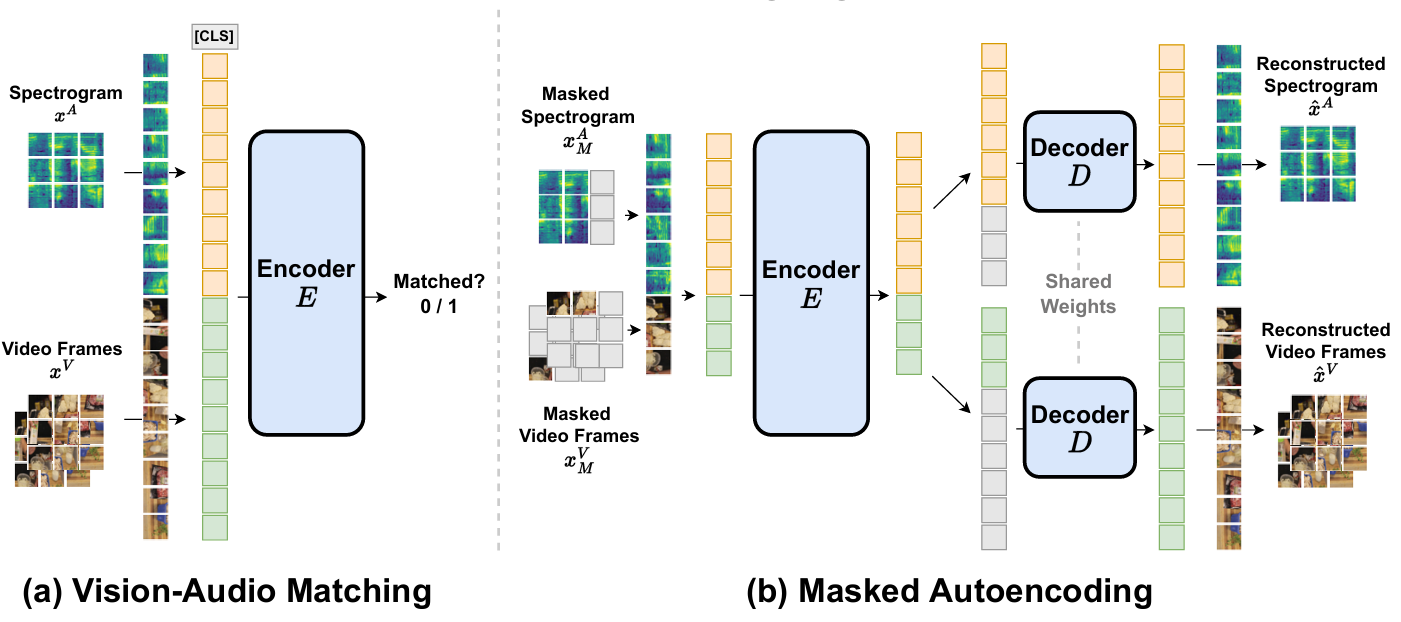
We only use decoder during pretraining for masked autoencoding objective
Only the encoder is used for downstream tasks
Pretraining Strategy
- Vision Audio Matching: for each video input we create positive vision-audio pair, then we construct half of vision-audio pairs as mismatched pairs. Model head is a linear + sigmoid layer applied to the [CLS] token output, predicts probability p of match
The matching label is y = 1 for aligned video–audio pairs and y = 0 for mismatched pairs.
- Masked Autoencoding (MAE): learn unimodal representations and improve robustness. Break video and audio frames into multiple small patches, mask 75% of visual and audio patches, send 25% unmasked patches to encoder, we send masked patches + encoders output to decoder. We also added temporal/positional/frequency embeddings at each patch before sending to decoder, decoder tries to guess the missing visual and audio tiles. We apply MSE on masked patches only. Decoder is scraped after pretraining. Encoder is penalized if its output fails to help decoder reconstruct the masked parts, so it learns to capture semantic structure of cross modal understanding.
The reconstruction losses are averaged over masked visual and audio patches.
Text based TVLT: same as vanilla TVLT with changes to process text inputs, uses a sentence piece tokenizer, maps tokens to trainable vectors, uses a affine layer decoder to recover masked words
Pretraining Datasets:
- HowTo100M
- YTTemporal180M
Downstream tasks:
- Video Based Tasks - audio to video retrieval, multimodal sentiment/emotion analysis
- Image Based Tasks - Visual Question Answering
Finetuning Procedure: we add a task-specific head on top of [CLS] token embedding, retrieval tasks: Binary cross-entropy on matching scores, VQA: Multi-label classification loss, Sentiment analysis: L2 Regression on sentiment scores
The paper reports competitive downstream performance and substantially faster end-to-end inference than its ASR-based text counterpart. Results depend on the task; the speed comparison includes the speech-recognition pipeline.
The original findings note says that text models outperform audio models on retrieval and that audio models have higher latency. These claims require the task and timing boundary to be specified. A model-only comparison with already available text differs from a spoken-input pipeline that must first run speech recognition.
In the paper’s end-to-end comparison, TVLT removes ASR and reports 28× faster inference than its text counterpart. Retrieval differences depend on the dataset and query modality. The notebook’s blanket latency statement therefore does not describe that end-to-end experiment.
TVLT — retrieval and efficiency comparisons
Pretraining details: steps 200K | optimizer Adam | learning rate 1e-5 | Batch size 4096 | decay rate 0.001 | cosine schedule | input 8 uniformly sampled video frames per clip | hardware 4xNVIDIA RTX A6000 GPUs | duration 2 weeks
Ablation studies: separate encoder vs joint encoder for both modalities explored, joint encoder outperforms separate encoders