An edge is a location where image intensity changes rapidly.
Edge detection: technique that identifies sudden changes in an image, marks border of objects
Edges arise due to:
- Changes in surface orientation
- difference in object distances
- different textured material
- shadows or lighting changes

Types of edges

Why do edge detection:
- helps in object recognition
- Helps analyze geometry of an object
- extracts useful features from images
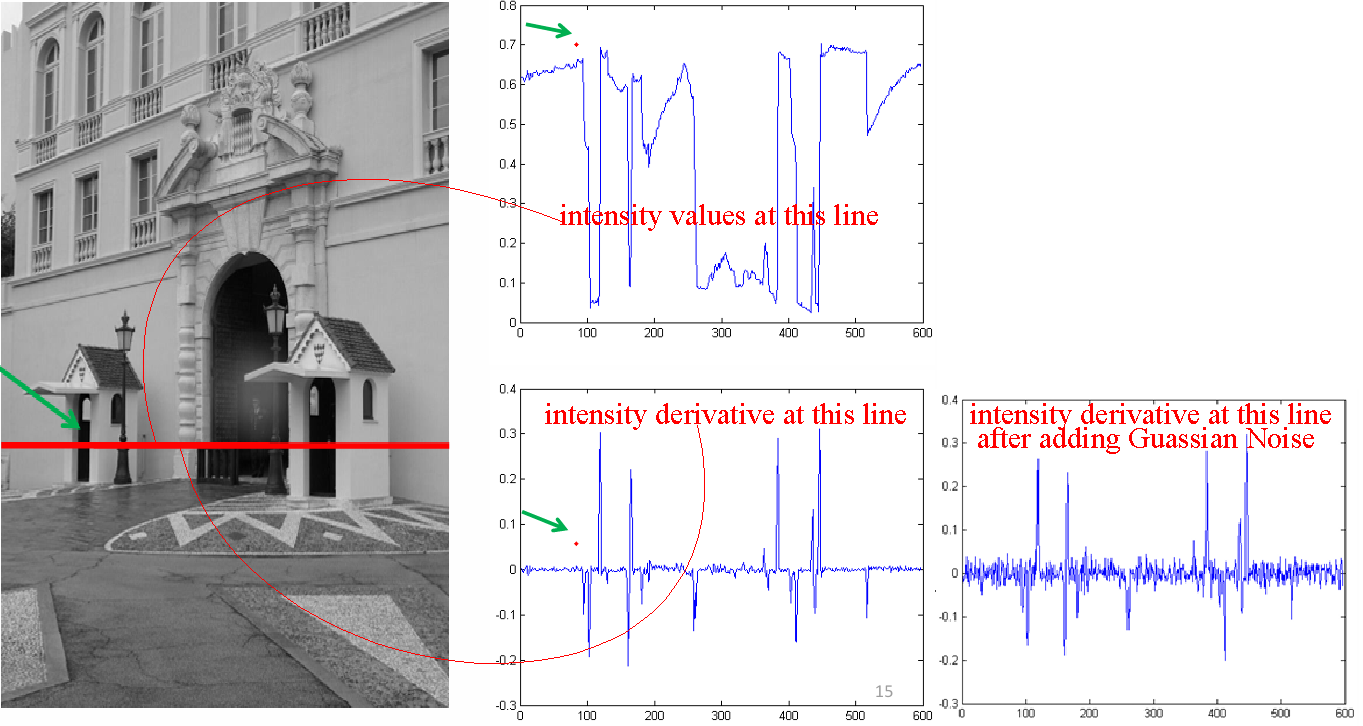
Smoothing: Smoothing reduces noise but blurs edges. smoothing before differentiation: apply a smoothing function (e.g. Gaussian filter) before computing derivatives.
Why Smoothing?
- Noise impacts edge detection by making pixels appear different from their neighbors.
- 'difference' filters (Sobel, Prewitt, Laplacian) respond strongly to noise.
- Filters mistakenly detects false edges due to noise.
Different kernel sizes affect sharpness. 1pixel→minimal smoothing, 3pixel→moderate smoothing, 7pixel→strong smoothing but edges become less precise.
Evaluating edge detection
TP: correctly detected edges, FP: incorrectly detected edges, FN: missed edges, GT: Actual edges present in image, Results of Method(RM): Edges detected by the algorithm.
Design criteria for edge detection:
- good detection - find all real edges while ignoring noise and artifacts
- good localization - detected edges should be as close as possible to actual edges
- minimal false detections - should not produce multiple responses for a single edge.
Challenges to edge detection

Edges are located at points where intensity changes significantly
Poor robustness to noise: Detects false edges.
Poor localization: Edges are not detected accurately.
Too many responses: Multiple detections for the same edge.
Derivative of images
Derivative: represents rate of change of function
Finite differences and gradients
| Approximation | Unit-step expression | Mask |
|---|---|---|
| Forward difference | f(x+1) − f(x) | [−1, 1] |
| Backward difference | f(x) − f(x−1) | [−1, 1], shifted |
| Central difference | (f(x+1) − f(x−1))/2 | [−1, 0, 1]/2 |
Two-dimensional derivative masks
These masks combine a central difference in one direction with accumulation in the perpendicular direction. Dividing the 1D central difference by two estimates the derivative per unit spacing. Unnormalized masks instead retain a scale factor. Reversing a mask changes the derivative sign.
Thresholding: technique used in image processing to convert a grayscale image into binary image by selecting a threshold value.
The Prewitt detector estimates horizontal and vertical derivatives, computes gradient magnitude, and uses a threshold to mark edges.
The Sobel operator gives more weight to central pixels in the perpendicular smoothing direction.
Worked Sobel example
Using the Sobel masks with valid cross-correlation (no padding), the responses are:
The nonzero gradients point horizontally. A magnitude threshold of 30 produces the following binary edge map:
Sobel calculation at one pixel
Repeating the same calculation over every valid patch gives the response matrices above. The notebook’s nonzero vertical response and approximately 44.72 magnitude were arithmetic errors: every input row is identical. With threshold 30, a response of 40 is an edge and a response of 0 is not.