Error analysis is a process where we identify and prioritize areas for improvement in algorithms performance
Before investing time, you should evaluate how much addressing this problem could reduce your overall error
Gather 100 mislabeled dev set examples
Count how many of these errors fall into specific categories such as dog images
For example, of 5% of them are dog images, addressing this would reduce the error from 10% to 9.5%
If 50% of errors are from dog images, fixing this issue would reduce the error from 10% to 5%
This method provides and upper bound on how much improving a particular issue could enhance overall performance
Error analysis in parallel
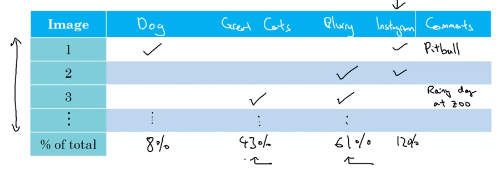
Andrew NG advises to build something quick and dirty.
Use that to do bias/variance analysis,
use that to do error analysis and
use the results of those analysis to help you prioritize where to go next.
Training and testing on different distributions

Train-dev set: subset of training data that is held out and used to diagnose variance(overfitting) or data mismatch problems
- If a model performs well on training set but poorly on train-dev set, it suggests overfitting
- If model performs well on both training and train-dev set but poorly on dev set, it suggests a data mismatch problem


Transfer learning
Train a NN on large dataset for initial task (Task A)
Adapt the pre-trained network for a new task (Task B) by modifying the network
And if Task B and Task A share similar input types,
Replace last layer and its weights with new randomly initialized weights for Task B
Depending on amount of data avaliable for Task b:
With a smaller dataset, only retrain the new layers
With a larger dataset, retrain the entire network (fine-tuning)
Training on task A is called pretraining
Multi-task Learning
MTL involves one NN performing several related tasks simultaneously
Each image in MTL can have multiple labels
Loss function in MTL computed by averaging losses for each individual task
MTL leverages the idea that related tasks can share low-level features, such as detecting edges or shapes in images
For MTL to be effective, NN must be large enough to handle complexity of multiple tasks, if the network is too small, MTL can degrade performance


End-End deep learning
Some ML systems have multiple stages to process input to outputs
End-to-end deep learning system implements all these stages with a single NN
We just need a big dataset
If we have a small dataset, ordinary implementation could work just fine
# Pipeline
audio -> features -> phonemes -> words -> transcript

# End-to-end model
audio -> transcript
Here end-to-end deep learning system works better because we have enough data to build it.
Image --> Bones --> Age # non-end-to-end system - best approach for now
Image ------------> Age # end-to-end system
In this example non-end-to-end system works better because we don’t have enough data to train end-to-end system.