The focus now shifts to images: how convolutional networks represent local patterns and build on them.
Valid convolutions: no padding
Same convolution: pad so that output size is the same as input size
Filter size, padding, and stride

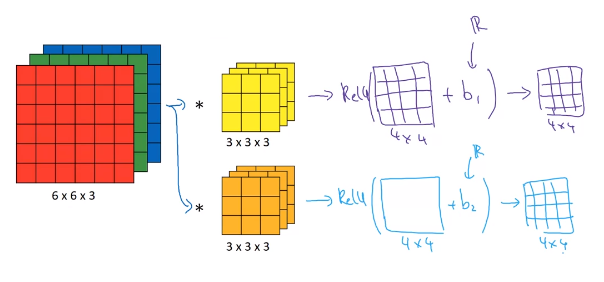


Pooling layers
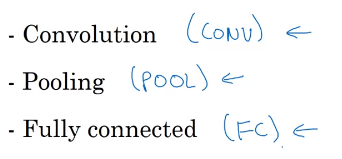
Types of layers in Covnet:

Pooling layers help reduce the size of the image representation, making computation faster and making some detected features more robust.
Think of pooling as a way to “summarize” a region of an image.
Why convolutions?
- Parameter sharing
A feature detector useful in one part of the image is also useful in another part
A filter, like a vertical edge detector, applied to various positions in the image can reuse the same parameters. This helps reduce the number of parameters
- Sparsity of connections
In convolution, each output unit depends only on a small number of input units. This sparsity leads to fewer parameters and connections, making the network less prone to overfitting and allowing it to handle larger images more effectively.
- Translation Invariance:
Convolutional networks inherently capture translation invariance, meaning that features detected by the network remain recognizable even if the input image is shifted.
One-dimensional and three-dimensional convolutions

Similarly for 3d volumes like CAT scan,
3D filters are used
