Generative Adversarial Networks ~2014
GANs are generative models that create new data instances resembling training data. GANs are heavily influenced by game theory (minimax). Was proposed by Ian Goodfellow, he came up with the idea in a single night, debated with his colleagues then implemented a proof-of-concept.
GANs consist of two networks:
- Generator: Produces data.
- Discriminator: Differentiates real and fake data.

Training Process:
- Generator starts producing low-quality fake data.
- Discriminator learns to classify real vs. fake.
- Generator improves to fool the discriminator.
- Eventually, the discriminator struggles to differentiate real and fake data.
Initially generator produces unrealistic data, but improves over time
Discriminator
Eventually discriminator struggles to differentiate real vs fake data
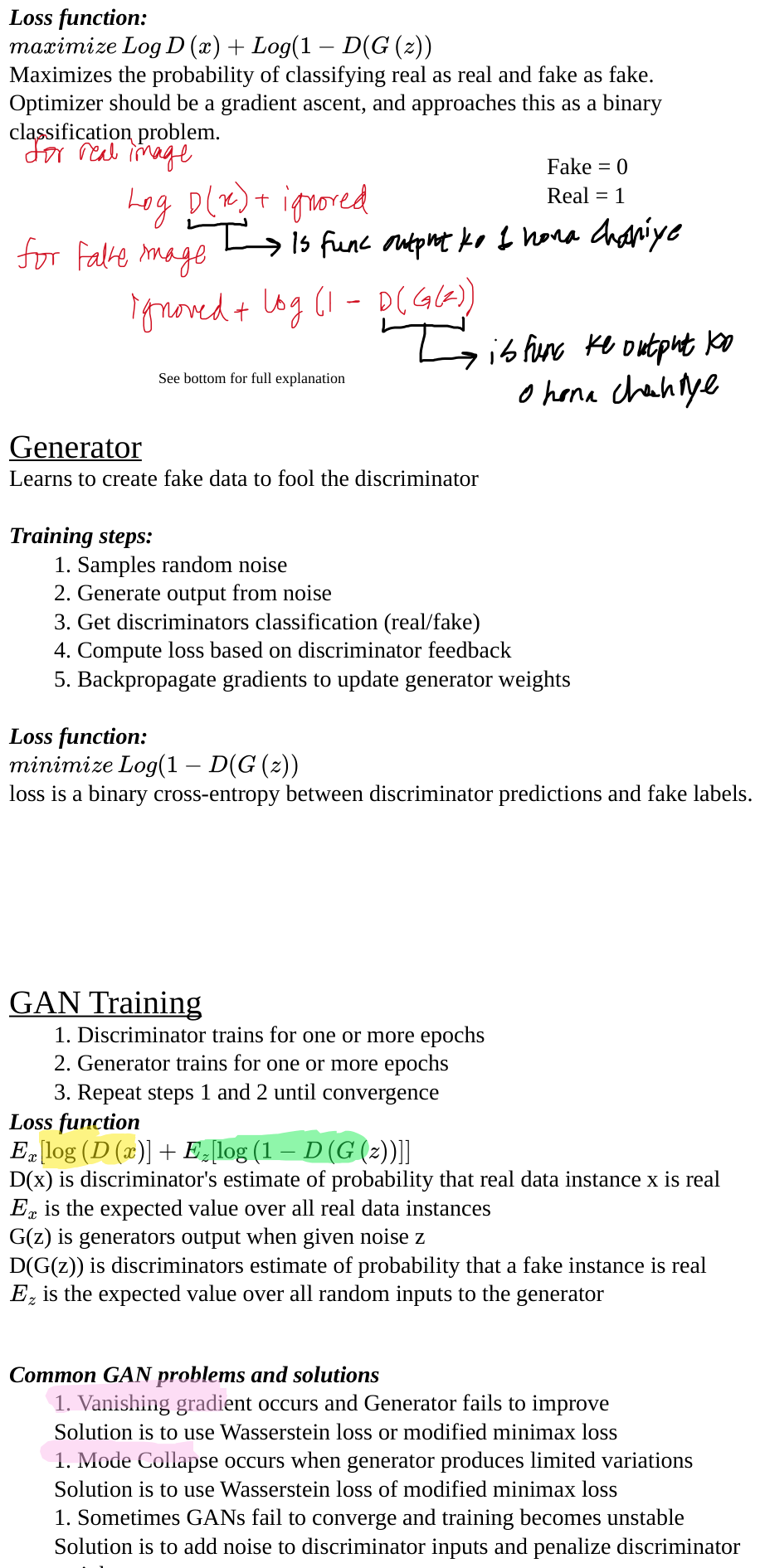
Is a CNN classifier model, has a training set that consists of real and fake instances. The loss function penalizes misclassifications.