Computer Security: Measures and controls to ensure the confidentiality, integrity, and availability of information system assets, including hardware, software, and data.
The focus of this course, is on:
1. What assets do we need to protect?
2. How are those assets threatened?
3. What can we do to counter those threats?
Key Objectives of Computer Security (CIA Triad)
Objectives that are at the heart of computer security
- Confidentiality
Ensures unauthorized users do not access sensitive information.
A loss of confidentiality is the unauthorized disclosure of information.
- Data confidentiality: private information is not disclosed to unauthorized individuals
- Privacy: allows individuals to regulate the collection, storage, and sharing of information about them and by whom.
- Integrity
Ensures correct and current data.
A loss of integrity is the unauthorized modification or destruction of information.
- Data Integrity: Ensures that data is only changed in approved ways.
A bank ensures that only authorized employees can update account balances. - System Integrity: Maintaining system integrity means protecting the system so that it continues to work correctly, even if someone tries to hack or manipulate it.
Imagine a security system for a building. If someone tries to tamper with the system to disable alarms or unlock doors without permission, it compromises the system's integrity. - Availability
Ensures systems are operational and responsive.
A loss of availability is the disruption of access to or use of information or an information system.
- Authenticity
Ensures something is genuine and can be verified as trustworthy. It involves confirming that users are who they claim to be and that all inputs come from trusted sources.
- Accountability
Requires tracking actions so they can be traced back to the responsible entity. This helps in nonrepudiation, fault detection, and legal action by keeping records for forensic analysis and dispute resolution.
Types of attacks and threats
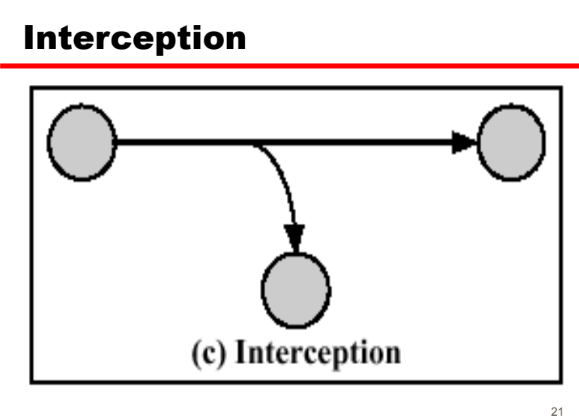
A threat is a danger that can affect the confidentiality, integrity, or availability of an asset and lead to potential loss or damage. The four illustrated categories are interruption, interception, modification, and fabrication.


Interruption
An asset is destroyed or becomes unavailable or unusable. This is an attack on availability. Examples include destroying hardware such as a hard disk and cutting a communication link.

Interception
Also called information disclosure or information leakage. An unauthorized party gains access to an asset: an attack on confidentiality. The party may be a person, a program, or another computer. Examples include monitoring or capturing network data and illegally copying files or programs.
Modification
An unauthorized party both gains access to and tampers with an asset. This violates integrity. Examples include changing values in a data file, altering a program so that it behaves differently, and modifying the contents of a transmitted message.

Fabrication
An unauthorized party inserts counterfeit objects into the system. This attacks authenticity. Examples include inserting false messages into a network and adding records to a file.


Real World Examples
Three levels of impact by a security breach:
| Low | Limited adverse effects, such as reduced effectiveness of functions, minor damage, minor financial loss, or minor harm to individuals. |
| Moderate | Serious adverse effects, including significant reduction in function effectiveness, significant damage, financial loss, or significant harm to individuals (not life-threatening). |
| High | Severe or catastrophic effects, leading to major loss of function, major damage, major financial loss, or severe harm to individuals, including loss of life. |
- Confidentiality
| Low | Directory information (e.g., student or faculty lists) is usually public and may have no confidentiality rating. |
| Moderate | Student enrollment information, though also protected, is seen by more people and poses less risk if disclosed. |
| High | Student grades, protected by FERPA, should be accessible only to authorized individuals. |
- Integrity
| Low | Online polls with minimal safeguards are expected to be inaccurate and are of low importance. |
| Moderate | A forum website with low importance may suffer from falsified entries or defacement with minimal damage. |
| High | Hospital patient allergy information must be accurate, as errors can lead to serious harm or liability. |
- Avaliability
| Low | An online telephone directory lookup has minimal impact if temporarily inaccessible. |
| Moderate | A university's public website may cause embarrassment if unavailable but isn't critical. |
| High | Critical systems (e.g., authentication services) must be highly available to avoid major financial and operational losses. |
The Challenges of Computer Security
- Complexity: Security may seem straightforward, but the mechanisms are often complex and require deep understanding.
- Attacks: Security designs must anticipate and counter unexpected attacks, which often exploit unforeseen weaknesses.
- Counterintuitive Measures: Effective security mechanisms can be intricate and may seem unnecessary until threats are fully considered.
- Placement: Deciding where and how to implement security mechanisms, both physically and logically, is crucial.
- Secret Management: Security relies on protecting secret information (e.g., encryption keys) and managing protocols that may complicate security.
- Battle of Wits: Attackers need to find only one weakness, while defenders must secure all vulnerabilities.
- Reactive Behavior: Users and managers often undervalue security until a failure occurs.
- Monitoring: Continuous monitoring is essential but challenging in fast-paced environments.
- Afterthought: Security is often added after system design, rather than being integrated from the start.
- Perception: Strong security is sometimes seen as a barrier to efficiency and usability.
| Term | Meaning |
| Hardware | Devices for data processing, storage, and communication. |
| Software | Includes operating systems, utilities, and applications. |
| Data | Files, databases, and security-related data (e.g., password files). |
| Communication Facilities | Network components like links, bridges, and routers. |
| Vulnerabilities | Meaning |
| Corruption | System provides incorrect data or answers due to modifications. |
| Leakiness | Unauthorized access to information through the network. |
| Unavailability | System or network becomes unusable or slow. |
| Term | Meaning |
| Adversary | Individual or group that intends to conduct harmful activities. |
| Attack | Malicious activity aiming to disrupt, deny, or destroy system resources. |
| Countermeasure | Technique or device to prevent or reduce adversarial activities. |
| Risk | Measure of potential harm and likelihood of an event occurring. |
| Security Policy | Criteria defining security services and maintaining system and data security. |
| System Resource (Asset) | Major application, support system, equipment, or personnel critical to operations. |
| Threat | Potential circumstance or event that could impact assets or operations negatively. |
| Vulnerability | Weakness in a system that can be exploited by threats. |
| Types of Attacks | Description |
| Active Attack | Alters system resources or operations. |
| Passive Attack | Monitors or uses information without altering system resources |
| Inside Attack | Conducted by an authorized user misusing access. |
| Outside Attack | Conducted by unauthorized users or entities outside the system. |
| Countermeasures | Description |
| Prevention | Measures taken to stop attacks from succeeding. |
| Detection and Recovery | Identifying and mitigating the effects of attacks when prevention fails. |
| Residual Risk | Remaining risk after countermeasures, which may still be exploited by attackers. |
