Historical context: the incident statistics, attack-era descriptions, and bounty amounts below are examples from the original course notes, not current market rates or current measurements.
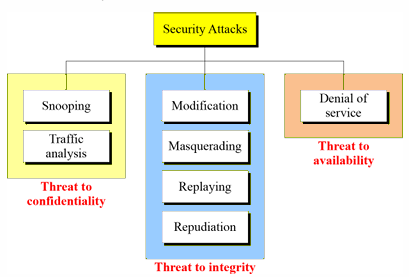
- Snooping – unauthorized access to or interception of data.
- Traffic Analysis – Obtain some information by monitoring online traffic
- Modification – the attacker intercepts the message and changes it.
- Masquerading or spoofing happens when the attacker impersonates somebody else.
- Replaying – the attacker obtains a copy of a message sent by a user and later tries to replay it.
- Repudiation
- sender of the message might later deny that she has sent the message
- the receiver of the message might later deny that he has received the message
- Denial of service (DoS) – It may slow down or totally interrupt the service of a system.
Threats and Attacks
- Unauthorized Disclosure
- Exposure: Direct release of sensitive data to unauthorized entities.
- Interception: Unauthorized access to data in transit.
- Inference: Gaining data indirectly through analysis or by-product characteristics.
- Intrusion: Accessing data by bypassing security measures.
- Deception
- Masquerade: Unauthorized access by pretending to be an authorized user.
- Falsification: Insertion of false data that misleads authorized users.
- Repudiation: Denying responsibility for actions, misleading others about actions taken
- Disruption:
- Incapacitation: Disabling or damaging system components to halt operations.
- Corruption: Modifying system functions or data to impair system operations.
- Obstruction: Interrupting service delivery by hindering operations or overloading systems.
- Usurpation:
- Misappropriation: Unauthorized control over system resources.
- Misuse: Causing systems to perform harmful functions, undermining security.
Threats and Assets
How Computer Assets can produce concerns in computer system
| Assets | Availability concerns | Confidentiality concerns | Integrity concerns |
| Hardware | Equipment theft or damage disrupts service. | Unencrypted USB drives can be stolen. | - |
| Software | Deletion of programs prevents user access. | Unauthorized copying of software. | Programs can be modified to fail or perform unintended tasks. |
| Data | Deletion of files prevents user access. | Unauthorized reading of data | Existing files can be modified or new files fabricated. |
| Communication Lines and Networks | Disruptions in communication deny service. | Messages can be intercepted, and traffic patterns can be observed. | Messages can be modified, destroyed, or fabricated. |
Data Security
Focuses on protection of files and data
- Availability: Ensuring data is not accidentally or maliciously destroyed.
- Secrecy: Preventing unauthorized access to data. This is the most researched area.
- Integrity: Protecting data from unauthorized modifications, which can range from minor changes to catastrophic impacts.
Secrecy Threats
- Direct Secrecy Threat: Unauthorized reading of data files or databases.
- Indirect Secrecy Threat: Statistical databases may unintentionally disclose personal information through analysis, especially when multiple datasets are combined.
History of Attacks in Cybersecurity
- Brain Virus (1986)
First MS-DOS virus, developed in Pakistan
Infected boot sectors of DOS FAT file systems
- Morris Worm (1988)
First internet-distributed worm
Disabled 10% of internet-connected computers
- Melissa Virus (1999)
Spread via email, exploiting MS Word and Outlook
Caused server shutdowns in major companies
- ILoveYou Worm (2000)
Spread through email attachments
Overwrote files and self-propagated via address books
- CodeRed Worm (2001)
Targeted Microsoft IIS web servers
Caused $2.5 billion in damages
- Nimda Worm (2001)
Spread via multiple vectors
Propagated globally in 22 minutes
- SQL Slammer Worm (2003)
Exploited Microsoft SQL server vulnerability
Significantly slowed global internet traffic
Current Trends in Cybersecurity (Post-2000)
- Early Hackers (Pre-2000)
- Young, socially isolated males
- Motivated by curiosity and notoriety
- Examples: Phone phreaking, early email worms
- Financial Motivation (Late 2000s)
- Shift towards profit-driven attacks
- Focus on spam, fraud, and identity theft
- Political Motivation
- Emergence of state-sponsored attacks
- Example: Stuxnet targeting industrial systems
- Modern "Botherders"
- Often young dropouts managing botnets
- Profit-driven, collecting sensitive data and spreading malware
Notable Incidents in Cybersecurity
- 419 (Nigerian) Scams
Example: Michigan Treasurer mistakenly sent $1.2 million of state funds due to a 419 scam.
- Zero-Day Attacks
Targeted software: Google, Excel, Word, PowerPoint, Office.
Risk: Lack of security patches for critical vulnerabilities leads to exploitation.
- Botnets
Stat: Vint Cerf estimates that 25% of all PCs on the internet are bots.
Modern Cyber Threats (Post-2010)
- Malware, Worms, and Trojans: Spread via email, instant messaging, and infected websites.
- Botnets: Improved encryption makes them harder to detect.
- Ransomware: Malware that encrypts victims' hard drives or launches DDOS attacks for ransom.
- Social Network Attacks: Attackers exploit users’ trust in online friends to launch phishing and other attacks.
- Cloud Computing: As usage grows, it becomes a prime target for cyberattacks.
- Web Applications: Often developed with insufficient security, making them easy targets.
- Budget Cuts: Reduced funding for cybersecurity personnel increases risks
Marketplaces for Vulnerabilities
- Bug Bounty Programs: Legitimate security researchers earn rewards for finding and reporting bugs.
- Example: Google offers $3,000, Mozilla offers $500, and Pwn2Own offers $15,000.
- Black Market: Cybercriminals sell discovered vulnerabilities, often for larger sums than legitimate programs.
Underground Economy
- Spam Service: Mass sending of unsolicited emails to promote scams or spread malware
- Rent-a-Bot: Renting access to a network of compromised computers (botnet) for various malicious activities
- Cash-Out: Converting stolen financial data into real money or assets
- Pay-Per-Install (PPI): Criminals are paid for every successful installation of malware on new victims' computers.