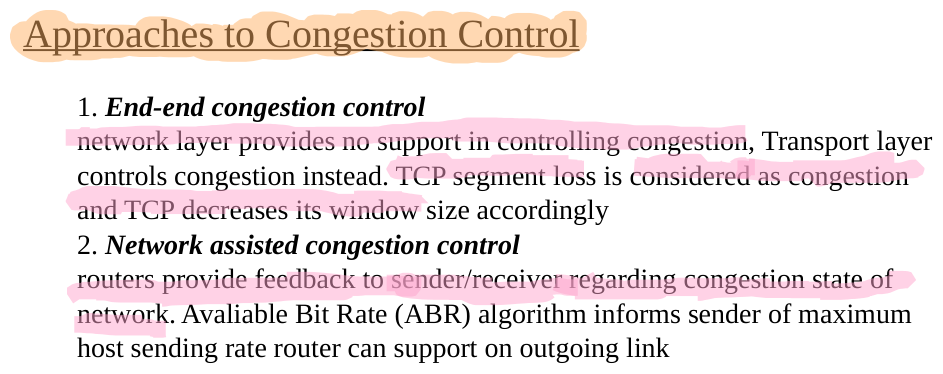
Packet retransmission treats symptom of network congestion, but does not treats cause of network congestion
Causes and Costs of Congestion
We'll look at three scenarios
Scenario 1: Two senders & router with infinite Buffers
Host A and B are connected by single hop with router of capacity R
Router has unlimited buffers just in case packet arrival rate exceeds outgoing links capacity
A sends data at average rate of bytes/sec
No error recovery, flow control, congestion control is performed
B sending data at average rate of bytes/sec too

Number of bytes at receiver vs
Number of bytes sent by sender graph

Sender sends data with some obvious delay
No matter how much increases, sending rate is capped by R/2
If approaches R/2 average delay increases (Large queing delays due to routers capacity)

Scenario 2: Two senders & router with Finite Buffers
We assume buffer is finite
We assume each connection is reliable (if a packet is dropped, sender will retransmit it)
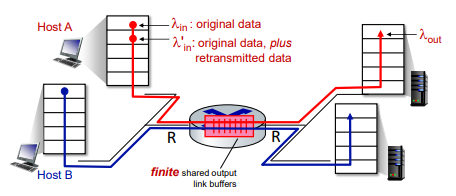
Application sends data into socket by bytes/sec rate
Transport layer sends segments at rate bytes/sec rate
is referred to as offered load


For small values of there are no buffer overflows
For larger throughput is also larger there are no buffer overflows
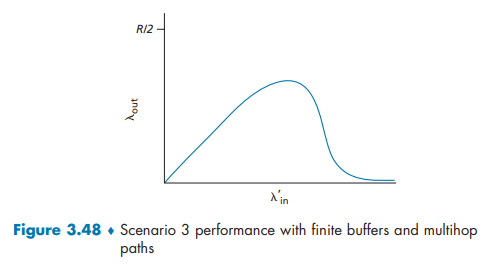
For Extremely large and A-C traffic passes by R2 with capacity R
If is large for B-D connection than A-C connection, then When B-D traffic increases A-C traffic getting past R2 gets smaller. When B-D traffic goes to infinity, R2 buffer is filled by B-D Packets only
This means A-C's end-end throughput goes to zero due to heavy traffic
Whenever packet is dropped at second router, work done by first router is wasted